Gotcha!
Why shock tactics in advertising work – most of the time
 Recently, I came downstairs and saw a leaflet that had landed on my mat.
(Sunday morning, I thought. Don’t these people ever rest?)
At first glance, it looked like just another advert, to join the growing pile, for everything from pizza-delivery to garden services, from estate agents to charity collections.
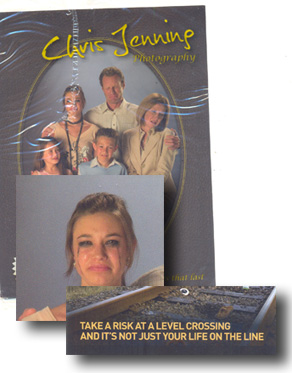
‘Chris Jenning Photography’, it was headed. And under a picture of mum, dad and the three kids, it said ‘family portraits’.
So far so normal.
Then I looked closer: Dad was grimacing, and mum was looking off to the right, forlorn and disconsolate. Both the girls were crying, one with mascara running messily down her cheeks. Their younger brother was also sobbing uncontrollably.
So what did I do? I flipped it over and read on, of course.
I’d been hooked.
‘Take a risk at a level crossing and it’s not just your life on the line,’ it started. ‘If you’re hit by a train, your loved ones will be hit just as hard.’
Recently, I came downstairs and saw a leaflet that had landed on my mat.
(Sunday morning, I thought. Don’t these people ever rest?)
At first glance, it looked like just another advert, to join the growing pile, for everything from pizza-delivery to garden services, from estate agents to charity collections.
‘Chris Jenning Photography’, it was headed. And under a picture of mum, dad and the three kids, it said ‘family portraits’.
So far so normal.
Then I looked closer: Dad was grimacing, and mum was looking off to the right, forlorn and disconsolate. Both the girls were crying, one with mascara running messily down her cheeks. Their younger brother was also sobbing uncontrollably.
So what did I do? I flipped it over and read on, of course.
I’d been hooked.
‘Take a risk at a level crossing and it’s not just your life on the line,’ it started. ‘If you’re hit by a train, your loved ones will be hit just as hard.’
What the FCUK?
Shock tactics in advertising are nothing new. French Connection in the UK has been doing it for years with its now-famous FCUK campaign. At one point, FCUK t-shirts were selling at the rate of one million a year. But in order to work, shock tactics need to do one thing – shock. And over time, that gets harder, as the ante is raised. Benetton has been consistently good at shocking, with ads featuring AIDS patients, copulating horses, and three identical hearts (labelled ‘black’, ‘white’ and ‘yellow’). Not to mention the hugely controversial Death Row campaign. Even when shocking ads are withdrawn, they continue to do their job. Sophie Dahl’s provocative pose for the perfume Opium was pulled, but is still remembered and luridly discussed (and viewed – if you dare – at her website www.sophie-dahl.com). Ryanair, the low-cost airline, consistently pushes the boundaries of good taste with its advertising. Just last month, it ran an advert in a Belfast newspaper to coincide with the British army’s withdrawal after almost 40 years. It showed a picture of Martin McGuinness, the Sinn Féin leader, with a speech bubble saying, “The company’s fares are so low even the army flew home”. It’s not true, of course, that the army flew Ryanair – but why let the truth get in the way of a good line? In any case, the tactic worked: it caused outrage and the advert was withdrawn. And Ryanair, not for the first time, got lots of free publicity. They’re no stranger to this. In 2006, Channel 4’s Dispatches programme went undercover to show what it alleged was the shocking truth behind the success of Ryanair (vomit quickly mopped up from a seat during the 25-minute turnaround, pilots flying right to the limit of the maximum hours allowed). And what happened? Bookings went up, of course. (As they did when a Ryanair pilot landed at the wrong airport in Northern Ireland, mistaking Ballykelly military airbase for City of Derry airport. It seems there really is no such thing as bad publicity.)Do it if you dare
So how far can you push shock tactics? Well that’s the million-dollar question. At some stage, you’ll probably reach the point of diminishing returns, where the loss of goodwill and the negative sentiment will outweigh the free publicity. Meanwhile, companies keep pushing. When Hell, a New Zealand pizza franchise, sent out a direct mail to advertise its new ‘Lust’ pizza, it thoughtfully included unusual topping – a condom. It also ran an advert with Hitler giving the Nazi salute with the quote from Mein Kampf: ‘It is possible to make people believe that heaven is hell’. When Jewish groups objected, the ad was pulled. Sometimes, though, shock tactics simply don’t work. A while back, I had lunch with a friend, before the smoking ban in England came into force. As he puffed his way through an intercoursal ciggie, my eyes wandered to the packet. ‘SMOKING KILLS!’ it screamed. “Doesn’t that worry you?” I asked. He blew a perfectly formed smoke ring and waved his hand dismissively. Obviously not. And the proposal to put photos of rotting gums, black lungs and stained teeth on cigarette packs? Would that scare him? “Not a bit,” he said with his gravelly smoker’s drawl. “They could put dead bodies on cigarette packs and it wouldn’t stop me.” I can’t say I was surprised. But I was just a little bit shocked.Categories
- Advertising (9)
- Art (1)
- Blogging (5)
- Blogs (3)
- Books (3)
- Branding (12)
- Communication (92)
- Content (1)
- Content marketing (1)
- Copycam (12)
- Copywriting (120)
- Creativity (8)
- Customer service (18)
- Design (2)
- Education (2)
- Grammar (10)
- Ideas (144)
- Internet (5)
- Language (24)
- Marketing (234)
- Music (1)
- Newsletters (2)
- Philosophy (3)
- Politics (8)
- Pricing (8)
- Productivity (15)
- Psychology (9)
- Punctuation (4)
- Sales (2)
- Sales letters (2)
- SEO (2)
- Service (7)
- Social media (5)
- Social networking (1)
- Technology (13)
- TED (30)
- Typography (1)
- Web design (2)
- Writing (40)