Are you tomorrow’s dinosaur?
Why it’s better to be the next big thing than the last one
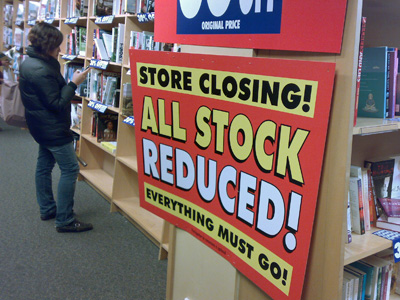
Bookshops without borders
A couple of weeks ago, I was in Waterstones and, sucker that I am for a bargain, found myself looking at their 3-for-2 offer on all paperbacks. When I’d eventually made up the numbers (good books don’t come in threes, do they?) I shuffled up to the counter. But stopped just short. What on earth am I doing? I asked myself. I returned to the shelves, replaced the books, pulled out my trusty Nokia and connected to the web. Two minutes later, bingo. Even at 33% off (you do realise that’s what 3-for-2 means, don’t you?) they were more expensive than Amazon. And so there and then, in enemy territory, I bought online and saved myself £3. I smiled the smile of the truly self-satisfied. Now it’s not the first time I’ve done this. A couple of years back, I pulled off the same trick in Borders – and look what happened to them. The picture above captures their dying days earlier this year, as I scavenged for a last-minute bargain. You might think I’d be wracked with guilt. Did I cause their downfall? Was that online purchase the straw that broke the camel’s back? Is there anything I can do to make amends? In actual fact, I feel nothing. The thing is, books have become commoditised. And with commodities, price almost always wins. What can a bricks-and-mortar bookshop do that an online shop can’t? Solve the need for instant gratification, I hear you say. Well yes, there is that, but with a little practice, even I can train myself to wait a couple of days for books. In any case, my reading pile is waist-high, so there’s no chance of me being bookless before they arrive. So what’s left? Good service? Please. This is a bookshop we’re talking about. English Lit graduates with outsize egos and attitudes to match. A lofty disdain for the lowly customer and an undeserved sense of entitlement. So price it is.Ask not for whom the bell tolls
These days, nothing is safe. Companies that don’t adapt die. Remember WordPerfect? I do. In fact, I used to work for them. And back in those days, there wasn’t anything that could come close to WordPerfect 5.1 for DOS. It was the pinnacle of word processing, and set the standard for the whole industry. And then it all went pear-shaped. WordPerfect backed the wrong horse – twice. First, things went GUI. Or in WordPerfect’s case, gooey. Would the future be OS/2 or Windows? The folks in Orem, Utah, thought it would be the former, and they threw all their resources behind development of a version for the IBM operating system. Wrong. Then, they missed the suite bandwagon. So while Microsoft was bundling Word with Excel, PowerPoint and Access to create the unstoppable Office, WordPerfect Corp. was left scrambling for apps to cobble together into an also-ran suite. Wrong again. And that was the beginning of the end. WordPerfect became the ghost of its former self that it still is today. So what can you do to avoid being the next casualty of a fast-changing world? Well here are my top tips:- Don’t bet the farm on one idea. Try lots of things and spread the risk. If an idea fails, so what? You have lots of others. And if one succeeds, do you abandon the others and run with that one alone? Don’t even think it. A single good idea can turn around in the blink of an eye. So stick with the safety-in-numbers approach.
- Keep your ear to the ground. What are the new ideas and trends in your market? What is the competition doing? What threats and opportunities are on the horizon? If you don’t know, find out.
- Adapt (or you know what). If the market’s changing, why aren’t you? If the competition’s changing, why aren’t you? And if nothing’s changing, why don’t you change anyway? You’ll be the one everybody notices.
- Be realistic, objective and dispassionate. See things for what they are, not how you’d like them to be. Don’t ignore the evidence or bury your head in the sand. Don’t hang on to a pet project if it isn’t working. Drop it and move on.
- Listen to your customers. They’re the single best source of market information you have. And guess what? They’re yours (for now). So use them often, and use them wisely.
- Mix it up. If you’re a gym bunny, you’ll know that changing your workout routine regularly is a great way to make sure you’re getting the most out of it. The same goes for your business. If it’s feeling like the same old same old, chances are it is – and you won’t be the only one who’s noticing.
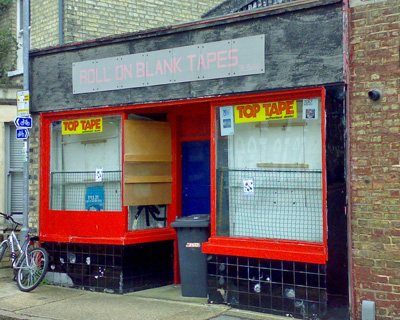
Today’s big idea can easily be tomorrow’s embarrassing one. Just like this shop I passed the other day near the centre of Cambridge. Can you believe that selling blank VCR tapes was ever a viable enterprise?
Categories
- Advertising (9)
- Art (1)
- Blogging (5)
- Blogs (3)
- Books (3)
- Branding (12)
- Communication (92)
- Content (1)
- Content marketing (1)
- Copycam (12)
- Copywriting (120)
- Creativity (8)
- Customer service (18)
- Design (2)
- Education (2)
- Grammar (10)
- Ideas (144)
- Internet (5)
- Language (24)
- Marketing (234)
- Music (1)
- Newsletters (2)
- Philosophy (3)
- Politics (8)
- Pricing (8)
- Productivity (15)
- Psychology (9)
- Punctuation (4)
- Sales (2)
- Sales letters (2)
- SEO (2)
- Service (7)
- Social media (5)
- Social networking (1)
- Technology (13)
- TED (30)
- Typography (1)
- Web design (2)
- Writing (40)